
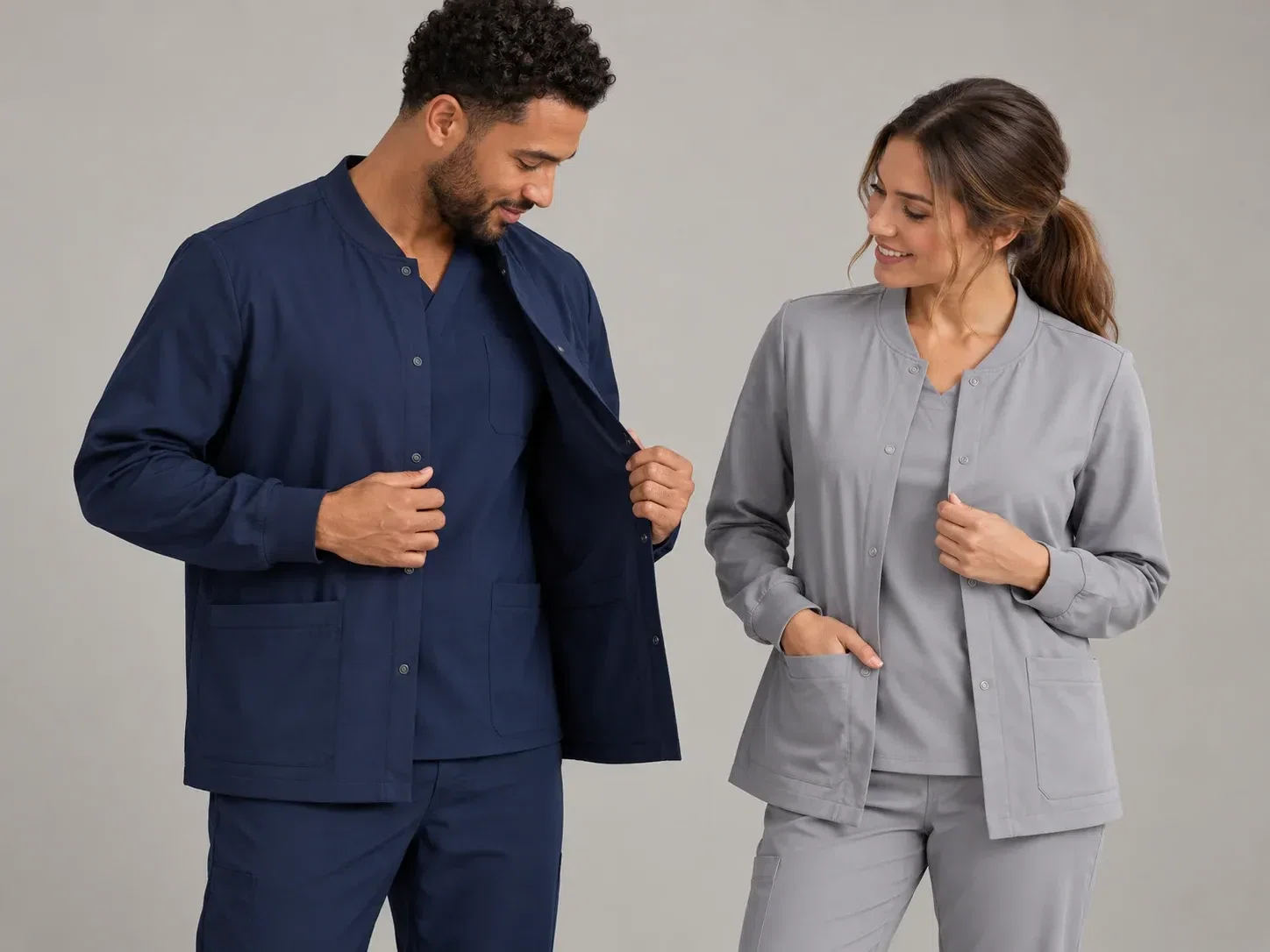
Medical jackets can feel uncomfortable over a long shift when the fit, fabric or details do not suit the wearer’s tasks. The useful fix is to identify the problem: restricted shoulders, an awkward cuff, excess warmth or a pocket that pulls the jacket out of shape.
For hospital procurement teams, clinic managers and nursing leads, jacket selection should start with staff activities and local uniform policy. A sample worn over the usual scrubs tells you more than an isolated fabric swatch or a promise of “all-day comfort”.
What are medical jackets, and where do they fit in the uniform?
Medical jackets are often sold as scrub jackets, warm-up jackets or nurse uniform jackets. They are an additional layer, commonly worn over scrub tops. The name does not tell you everything about the garment: check its cut, closure, fabric and intended use.
For example, Cherokee’s scrub-jacket collection uses both “scrub jacket” and “warm-up jacket” for different styles. A lab coat is a separate garment category, so specify which type of layer your team needs.
Before choosing long sleeves, cuffs or a particular jacket style, confirm your facility’s dress rules for the role and setting. CDC guidance distinguishes jackets worn for comfort or identification from personal protective equipment. An ordinary uniform jacket does not replace required protective clothing.
Start with the shift: identify when discomfort appears
Ask staff to describe the task and location associated with the problem. A jacket that works at a reception desk may feel different during repeated reaching, seated documentation or movement between rooms.
Separate temperature concerns from fit concerns. If a nurse feels cold while seated but too warm during activity, trial a manageable layering arrangement rather than simply requesting a thicker jacket. If the shoulders pull during reaching, inspect the cut and available ease.
| Staff feedback | What to assess | Trial condition |
|---|---|---|
| Shoulders pull during movement | Shoulder width, armholes and upper-back allowance | Reach forward over the normal scrub top |
| The jacket bunches when seated | Body length, hem and front closure | Sit and work at a desk |
| Cuffs feel restrictive | Opening, construction and sleeve length | Check wrist comfort and required tasks |
| Loaded pockets drag | Pocket location, depth and garment support | Carry the usual permitted items |
| The jacket feels too warm | Fabric, layers and activity level | Compare samples during similar duties |
Record recurring complaints by garment style and size. This helps distinguish an individual fit issue from a detail that needs changing across the team.
Compare fabric and layering as a complete combination
Request the fabric composition, weight, construction and finish for each proposed medical jacket. Include the washing and drying instructions in the comparison. “Soft”, “stretch” and “breathable” should lead to specific questions and sample checks.
Wear the sample over the scrub top normally used by the team. Check how the surfaces move against each other, whether sleeves bunch and whether the combined layers feel suitable during work. A jacket evaluated over a thin T-shirt may give a different result over the actual uniform.
If a supplier proposes stretch fabric, ask about stretch direction and recovery, then assess movement and shape on the sample. Fibre percentages alone do not establish how easily a jacket moves or how it fits after use.
Coordinate the trial with your medical scrub requirements. Evaluate any claimed moisture-management performance using evidence for the proposed fabric; do not assume that all cotton, polyester or blended jackets behave alike.
Choose women’s, men’s and unisex fits by measurements
Illustrative product styling
Review medical jacket fit
Compare layering, cuffs, pockets and movement over the usual scrub top before approving your healthcare uniform specification.
Explore medical jackets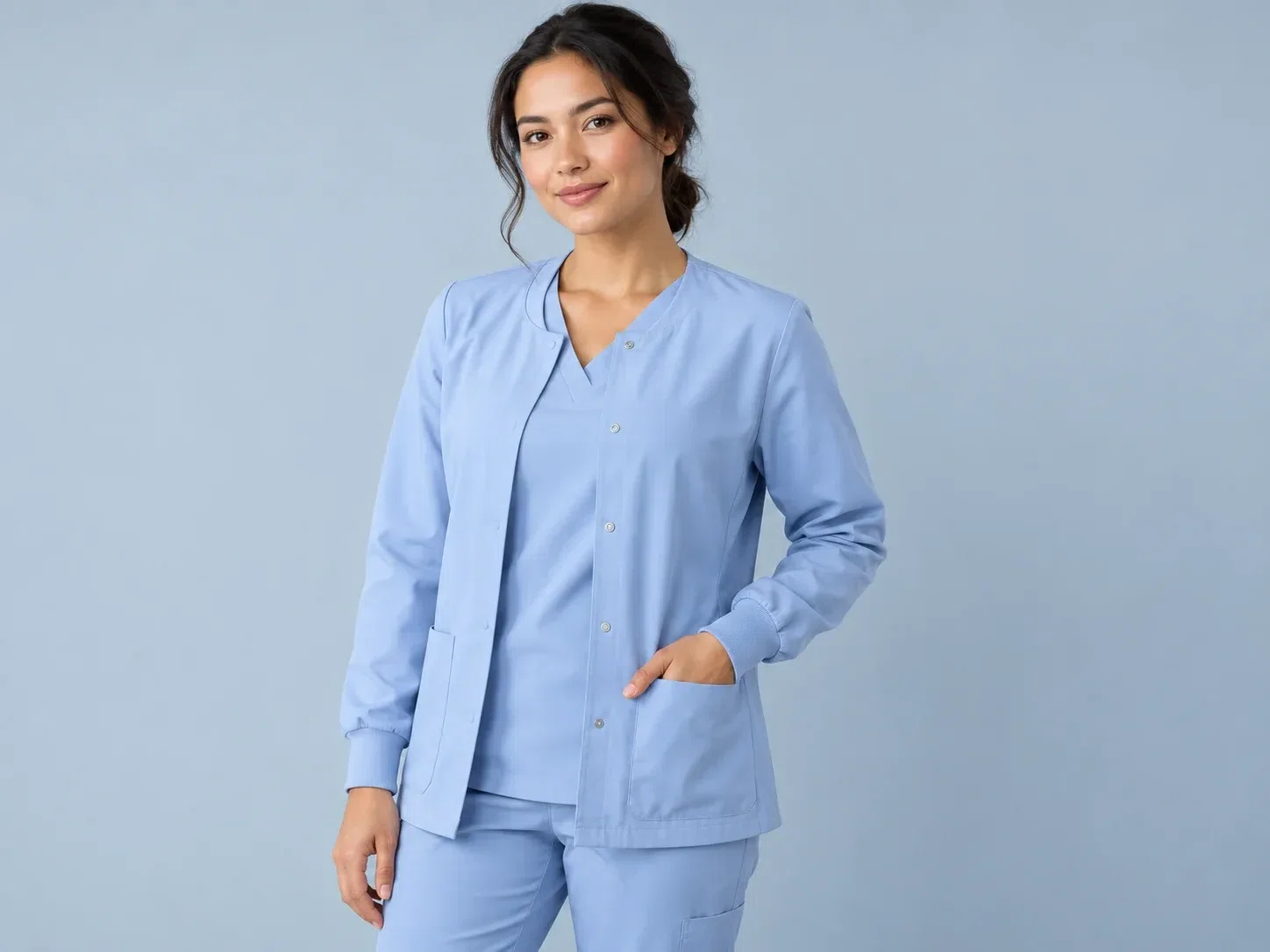
Women’s medical jackets, men’s medical jackets and unisex styles can have different proportions. Choose from the garment’s measurements and the wearer’s needs rather than treating the category label as a fit guarantee.
Check chest allowance, shoulder width, sleeve length, body length and room at the hips. For a scrub jacket for women, assess whether shaping restricts movement when the front is closed. For men’s or unisex styles, check that extra width does not create unnecessary bulk.
Use the size chart for the exact style and confirm whether it lists body or garment measurements. During fitting, staff should close the jacket, sit, reach and check pocket access while wearing their normal scrubs.
Record the selected jacket size independently from the scrub-top size. Where available, trial alternative lengths or cuts for staff who fall between standard options. Confirm these arrangements in the quotation rather than assuming they are included.
Inspect closures, cuffs and pockets during ordinary tasks
Zip-front and snap-front jackets offer different handling and appearance. Test the proposed closure while seated and standing. Check for pressure at the neckline, a hem that catches and any difficulty opening or closing the garment.
For cuffs, assess comfort and sleeve position alongside the facility’s requirements. Do not assume that a tight cuff, loose sleeve or removable layer is permitted in every clinical area.
Load pockets with the items staff are normally allowed to carry. Check access, balance and how the jacket hangs. A larger pocket is not automatically more useful if it pulls the garment or places its contents awkwardly.
Inspect inside seams and labels, too. Rough edges, bulky joins or an uncomfortable neckline can matter even when the jacket looks polished from the outside.
Personalised medical jackets: approve embroidery for comfort
Names, job titles and an organisation’s logo can help identify staff. For personalised medical jackets, approve wording and placement alongside the practical garment details.
A medical jacket with embroidery needs a physical decoration check. Inspect the reverse of the logo for backing, bulk and contact with underlying layers. Confirm that the design does not interfere with a closure, pocket or identification badge.
Madeira’s embroidery guidance identifies stitch density, tension and backing among the factors affecting fabric distortion. Ask to review the logo on the proposed garment fabric, not only on a digital image.
For organisation branding, discuss hospital logo embroidery with the approved artwork, finished dimensions and placement. Keep a checked staff-name roster to reduce personalisation errors.
Confirm laundering requirements before the bulk order
Establish whether jackets will be cleaned through a facility-managed service or another approved arrangement. Ask the supplier to confirm that the proposed garment and decoration suit that process.
CDC’s healthcare laundry guidance states that facilities requiring uniforms should provide laundering arrangements or task-appropriate cleaning guidance. Use your organisation’s current policy to set the requirements; generic garment-care advice is not a substitute.
Illustrative product styling
Plan a healthcare jacket order
Share your staff roles, size range, quantities, logo artwork and laundering requirements for a specification-based quotation.
Request a medical jacket quote
Where sample wash checks are agreed, record the process and compare fit, appearance, closures and decoration afterwards. Define acceptable changes before ordering. A brief trial can reveal issues but does not establish the garment’s full service life.
What should healthcare buyers include in a jacket brief?
- Roles, work settings and applicable uniform requirements.
- Garment style, colour, fabric specification and layering needs.
- Sizes and quantities, with fit-trial feedback.
- Closure, cuff, pocket and label details.
- Logo files, names, titles and approved decoration positions.
- Laundering arrangements, sample requirements and required arrival date.
Compare quotations against this same brief. Confirm sample costs, decoration, delivery, minimum quantities and estimated turnaround. Retain approved specifications and sample references so reorders can be checked for changes.
Medical jacket FAQs
What are medical jackets called?
Common names include scrub jackets, warm-up jackets and nurse jackets. Specify the actual garment style because terminology varies between suppliers.
What is the best hospital jacket?
The best option is one permitted for the role that fits over the usual uniform and performs acceptably in movement, comfort and laundering checks. There is no single style that suits every department.
What are some good jackets for medical professionals?
Zip-front, snap-front and other approved scrub-jacket styles are options to evaluate. Compare fit, temperature comfort, storage and care requirements using physical samples rather than selecting only by brand.
What is a nurse’s jacket called?
It is often called a nurse jacket, nursing warm-up jacket or scrub jacket. A lab coat is a different garment, so clarify the intended style when ordering.
Plan medical jackets around the people wearing them
Improving long-shift comfort begins with task-specific feedback. Check the jacket over the normal uniform, assess its details during work and confirm the laundering process before approving the order.
Masswear Uniform manufactures to buyer-agreed requirements and provides free mockups before production. Minimum order quantities and estimated turnaround are confirmed in the quotation; discuss physical samples separately.
Review custom medical jackets and share your team’s quantities, sizing needs, logo artwork and comfort priorities to start a specification-based enquiry.
Frequently Asked Questions
Common questions related to this article.